

Despite what kids today and motherboard designers wish to believe, floppy disks and LS-120 drives are still in use. Many Cessna and other plane models have floppy drives built into them for log extracts and updates. Not just little planes either.


You don’t replace a multi-million dollar jet or a $30+K test system just because someone thinks floppy disks are obsolete. In order for these things to load from a disk, you must first put something on the disk, and that means you need a computer with a functioning drive.
What are your options?
Yes, I’ve written about floppy drives before. In some articles I’ve predicted floppy disks will last longer than your Internet storage services. Laugh all you want man, once purchased the floppy requires no electricity to maintain that which you write on it. Just put it on a shelf and rotate it from time to time to avoid that screw driver becoming magnetic thing. Your Internet storage service, as well as crypto currency, are massive contributors to global warming. They are reviving coal fired power plants just to generate the electricity they need. Even if you are too stupid to realize “once in a hundred year” storms are happening once every couple of years now, you have to realize electricity isn’t free. Whatever storage service you use today will go bust tomorrow under crushing debt trying to pay for all the juice it needs.
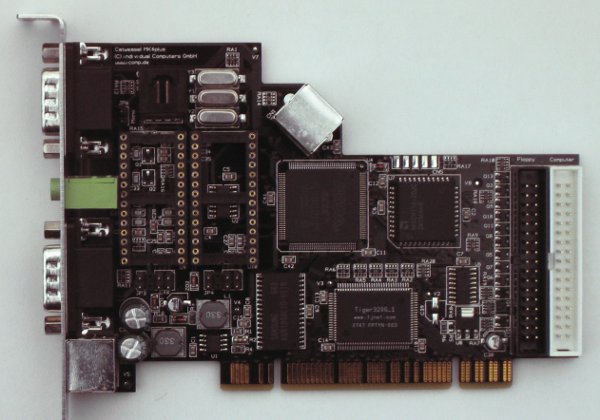
You will find a booming niche business buying/selling PCI bus based multi-I/O cards. Two serial ports, IDE, and floppy controller. You will also find that Windows and most Linux distros have drivers for these things.
Some people and companies try to be cheap. The scour places like PCLiquidations for systems that came with floppy drives or at least have the PCI slots to make the Multi-I/O cards work. Then they hold their breath hoping it will run as long as they need it to.
Other places realize you have to pay to play in this world. There are niche companies with custom built brand new systems having PCI slots. Yes, you can still buy ISA slot MS-DOS based computers from them. You can even find a wiki on how to repair/maintain your existing floppy drives. Of course, you can also find help on Reddit.
I do hope they keep this system available for quite some time. If you scroll down you will notice the 6th gen i-7 motherboard with 32GB of RAM has a floppy header. They don’t sell the floppy drives though, at least not via that form.
What is your use case?
Yes, I spoke of cheap people trying to find old equipment in the “refurbished” market. If you are just trying to load patterns into one of those automated sewing machines for home use, that’s an option for you. The industrial user, especially the medical device manufacturer who just has to maintain the system that went through FDA 510K approval process, ponies up for the industrial grade computer. It can cost millions to get through a 510K process, so two grand for a spare industrial computer is cheap.
Private pilots and other non-critical, for lack of a better phrase, users will purchase a USB floppy drive. Yes, Linux can support these as well. I’ve written about them before. The problem with these drives (I own several) is that they are USB. People plug them in, write some floppies, then put them back in a box, or worse, their soft laptop carrying case. Given the physical abuse they suffer they have short lives. Usually they get so physically damaged the wiki tricks won’t bring them back to life.
Despite all of the bitching
Yes, I love my LS-120. I’m not the only one. The prior Reddit link in this article has quite a few people hoarding these drives. I have several still supposedly new sitting on a shelf in the office. When I’m writing a book, these are my preferred backup medium. I can write on the label, it fits in my shirt pocket, and 120MB holds many different versions. Yes, they are slow by modern standards, not to mention noisy, I don’t care. My off-site backup is taking one home from the office.
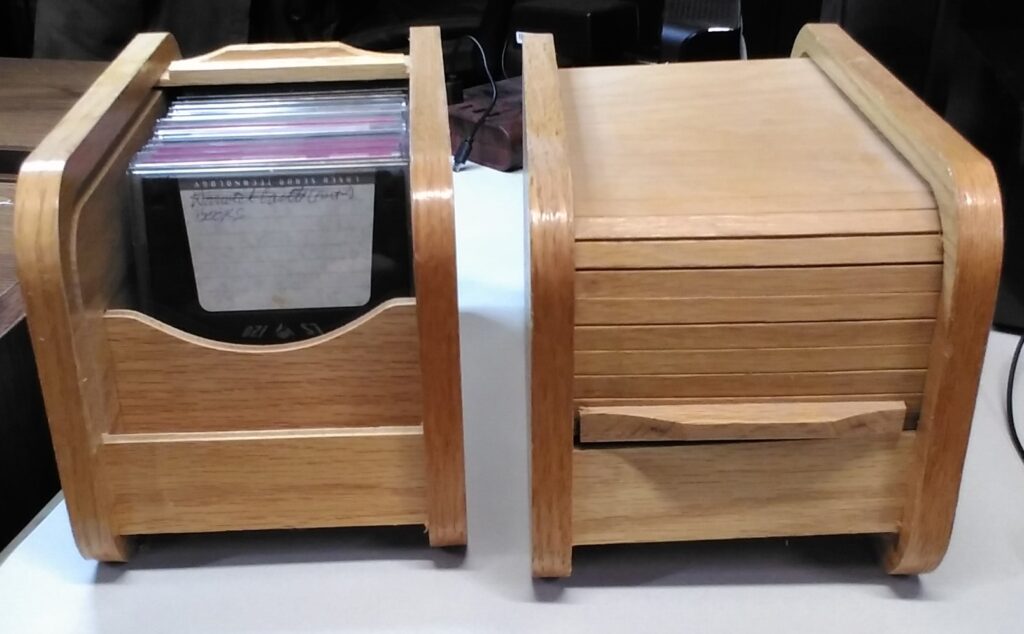
I even have some fancy wood cases for the disks.
Motherboard manufacturers try to screw us
So, you finally bought that new be-all-end-all motherboard. You custom built a system to make your friends drool. Then, you tried to get your floppy, LS-120, or other “legacy” media to work. At that moment there was great sadness.
I just built a new system based on an ASRock B550 PRO4 motherboard. AMD Ryzen 5 CPU with 32GB of RAM. An MSI GeForce GTX 1650 video card and an 850W power supply. (I don’t play games, I do embedded systems development.)
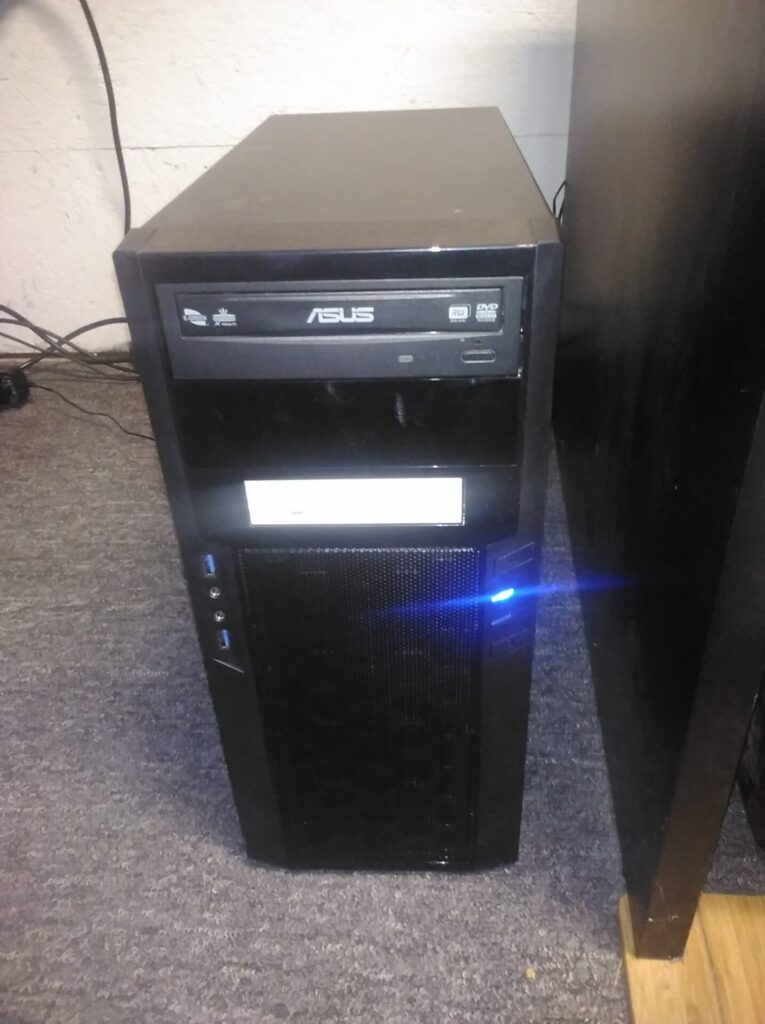
Flash from the camera kind of bleached out my LS-120 drive. There was great sadness when I booted my GParted thumb drive to prep the “disks” before install. You could see it, but not do anything with it.
For this, and many other mobos, you have to get into the BIOS and navigate to CSM (Compatibility Support Module).

Then you want to change the Storage OpROM policy.
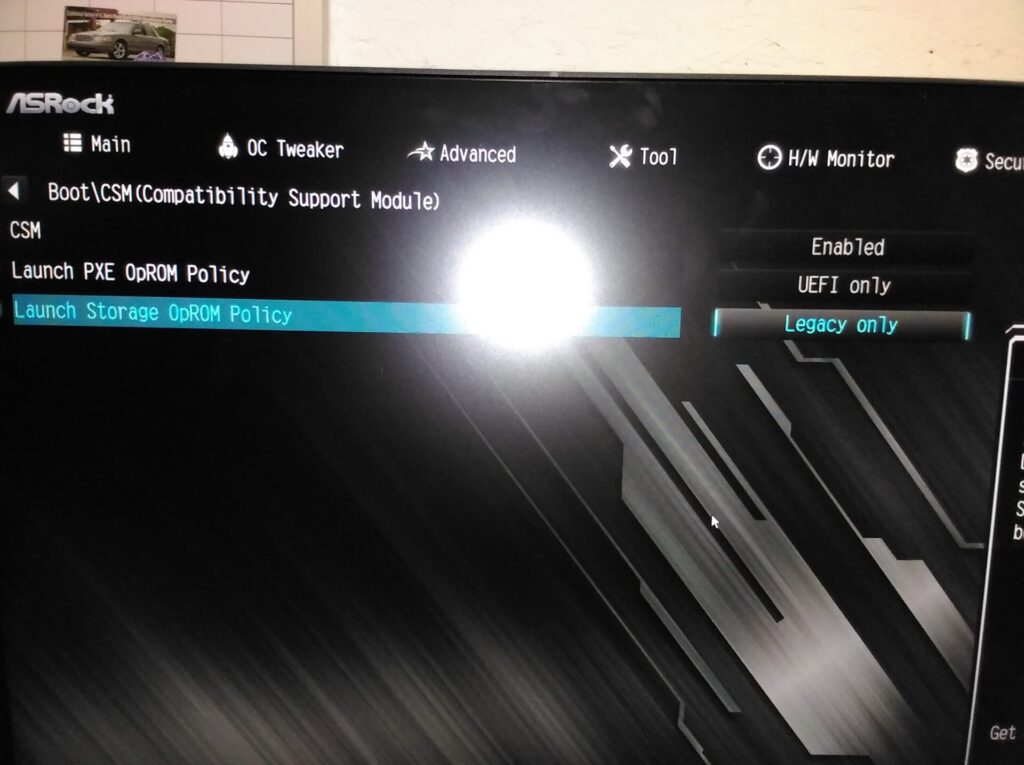
Again, sorry for the flash.
By default both of these are set to UEFI only. Any media not capable of UEFI booting will not work. You will most likely be able to “see” the drive, but that’s it. CachyOS and Ubuntu 24.04 will randomly crash if you have “Legacy” devices connected without enabling this in the BIOS. Something about the device polling where the OS checks for newly connected devices and inserted media.
In another few years they will probably try to take this option away from us so we will all be buying industrial computers.
